
Why Economic Crises Do Not Always Topple Autocrats
The Survival Manual of Hybrid Regimes—Part I

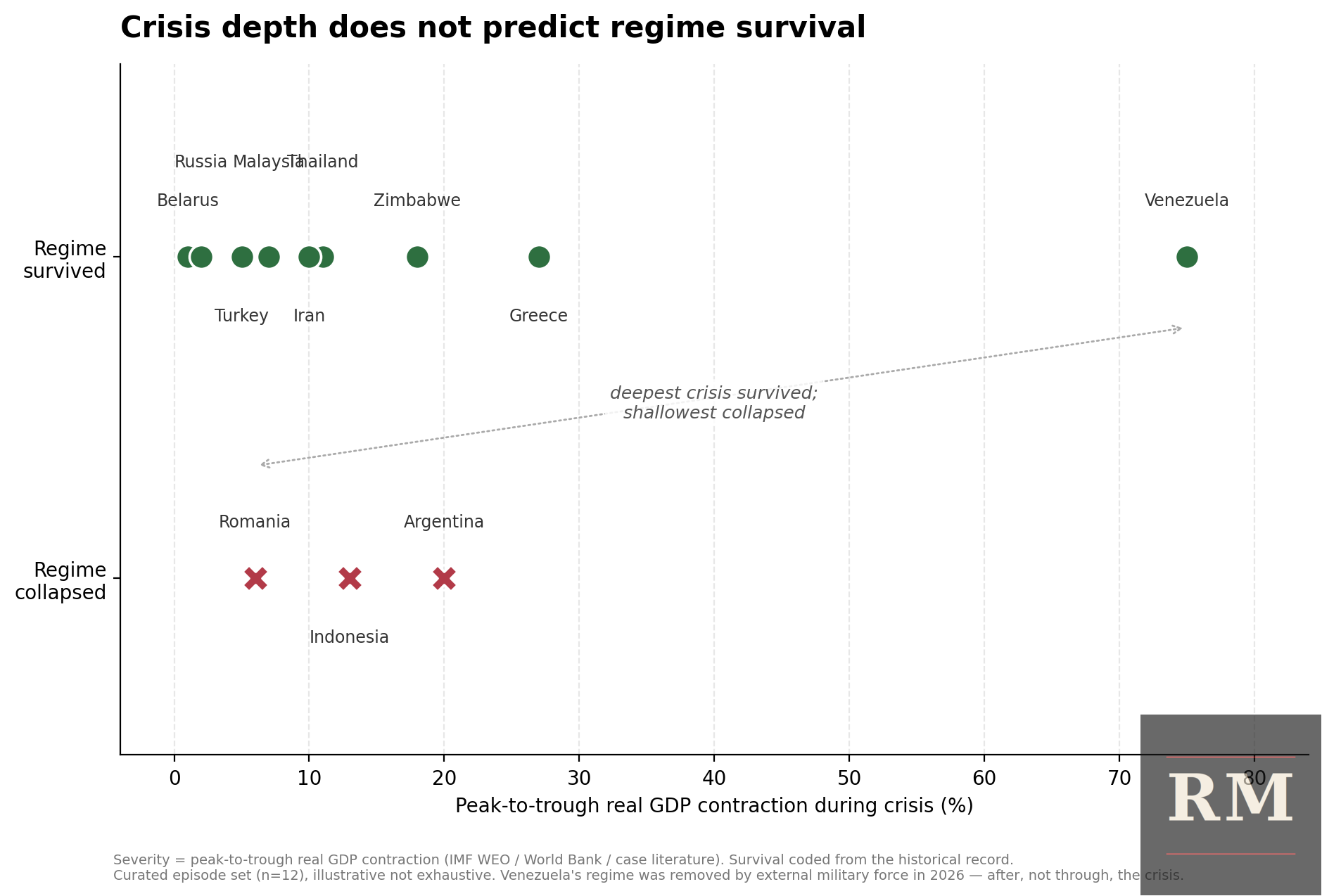
Venezuela's economy shrank by roughly 75% between 2013 and 2021 — one of the largest peacetime contractions on record, worse than the U.S. in the Great Depression. Chavismo outlasted it. Maduro governed through the entire collapse, and when he finally left office in January 2026, it wasn't the economy that removed him—it was a U.S. military operation that captured him and flew him to New York to face narco-terrorism charges. His vice president, Delcy Rodríguez, was sworn in within days, and the PSUV apparatus still calls him the legitimate president from his cell. A decade of sanctions and hyperinflation never produced that outcome; a raid did. Turkey's lira lost about 80% of its value between 2018 and 2023, inflation peaked above 80%, and Recep Tayyip Erdoğan won the 2023 presidential election anyway. Contrast both with Romania in 1989: a much shallower economic decline, and the regime was gone within days.
These cases don’t show that autocrats are economically invincible. They show something narrower: crisis size barely predicts whether a regime falls and barely predicts what finally takes it down. What predicts collapse is whether the crisis breaks two things—the regime’s ability to tell people whose fault it is and its ability to keep the people who matter loyal while everyone else absorbs the damage. Venezuela is what it looks like when neither breaks. The regime doesn’t fall on schedule; it just ends up removed by something apart from the crisis.
Plotting a set of crisis episodes against whether the incumbent regime survived them makes the disconnect visible. If depth of contraction drove collapse, the collapsed regimes would cluster on the right and the survivors on the left. They don’t. The two clear collapses—Romania in 1989 and Suharto’s Indonesia in 1998—sit at shallower contractions than Venezuela, Zimbabwe, and post-2008 Greece, all of which survived. Severity is scattered across both outcomes with no visible slope.
So the question isn't how deep the crisis runs. It's what a regime can do with a crisis of any depth.
Blame has to Land Somewhere
Economic pain doesn’t translate into political action on its own. Someone has to be blamed, and enough people have to agree on who. In a democracy, this step is almost automatic—an incumbent’s name is on the ballot, and voters punish accordingly. Powell and Whitten’s (1993) classic finding, replicated across dozens of democracies, is that unemployment and inflation predict vote share with remarkable consistency. That’s the baseline everyone has in their head when they wonder why the government in Turkey didn’t share that fate, or why Maduro governed for thirteen years after the collapse began.
What actually happens is that hybrid regimes don’t skip this mechanism — they capture it. The Erdoğan administration met the 2018 currency crisis by calling it “economic terrorism,” a foreign plot rather than a policy failure. Pro-government media reframed the story around infrastructure and Turkey’s rising regional weight instead of the lira. Guriev and Treisman (2019) have a name for the broader pattern: informational autocracy, a mode of control built on persuasion and selective information rather than blunt censorship. It shows up in the data, not just the rhetoric—Rozenas and Stukal (2019) found that Russian state television’s coverage of inflation bore almost no relationship to the actual price data households were living with. None of this evidence requires convincing everyone. It requires convincing enough people while keeping the ones who could act on disbelief—the military, the security services, and key economic elites—sufficiently insulated so that their skepticism never turns into defection. A narrow coalition is fine as long as it holds; a hundred million angry citizens are only a threat if any of them are in it.
All of this severs a link that holds tight in democracies. There, incumbent vote share tracks economic performance closely enough to be one of the more reliable regularities in the field—the worse the economy, the worse the incumbent does. Under electoral authoritarianism, the same relationship goes slack. The economy still deteriorates; the vote barely registers it because the channels that would carry hardship into lost support—independent media, credible challengers, and a clean count—have been captured or blunted. The two panels below map the same input, economic performance, onto the same output, incumbent support, across the two regime types: a steep slope on one side, a near-flat cloud on the other.
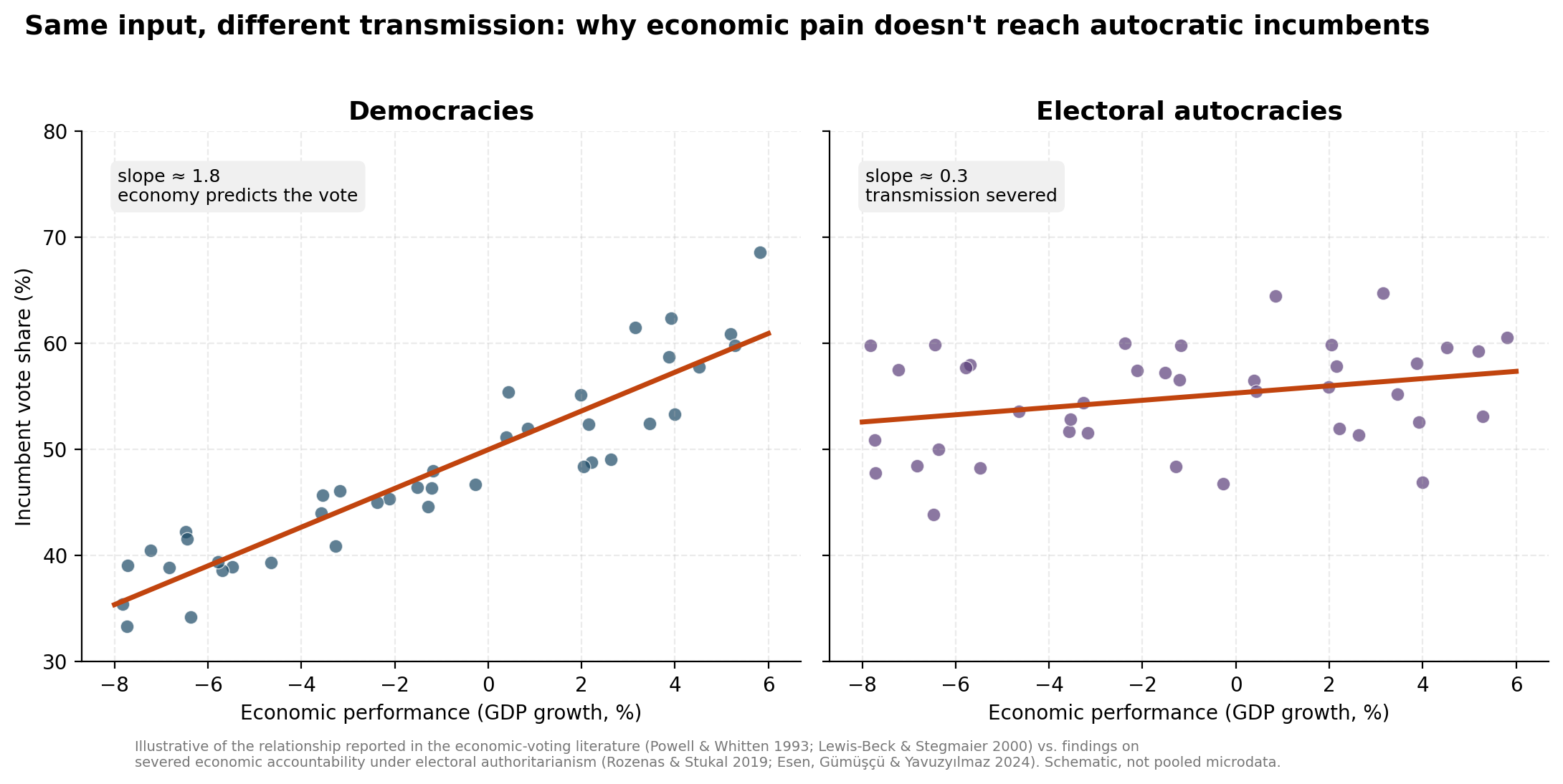
The left panel is accountability working as designed. The right panel is the whole problem in one image: the wire between economic pain and political consequence, cut.
Who Bears the Cost is the Real Question
This is the piece the standard economic-voting model misses: it treats “the economy” as one variable acting on one undifferentiated public. But hybrid regimes never face an undifferentiated public. They sort it — deliberately — into the people they need and the people they don’t, then steer the damage toward the second group.
Venezuela’s CLAP food-box program, oil rents channeled to military command, and preferential currency access for regime loyalists didn’t fix the economy. They didn’t need to. They kept the actors capable of ending the regime fed, paid, and better off than the alternative, while everyone else lived through hyperinflation and the largest refugee outflow in modern Latin American history. It worked for over a decade — long enough that when the government did fall, the trigger was a foreign military capturing its president, not a domestic coalition deciding it had had enough. The Erdoğan administration ran the same logic on a milder scale—subsidized credit and energy price controls aimed specifically at the rural and lower-income base its coalition depends on, even as the broader economy cratered.
This approach works at street level too, not only in the national narrative. Jose Morales-Arilla (2025) traced Venezuela’s 2019 nationwide blackouts and found the regime rationed power restoration by political geography: areas that had voted for Maduro got their electricity back first, while opposition strongholds absorbed longer outages, more protest, and more repression. The same government, twenty years earlier under Hugo Chávez and still democratic, handled the 1999 Vargas floods without that targeting—reconstruction spending was distributed roughly evenly regardless of how a region had voted. What changed between the two disasters wasn’t Venezuela’s poverty or its geography. It was whether the people running the response still had to worry about losing an election. Han’s (2021) survey work across 22 African autocracies finds the same logic at the level of individual attitudes: citizens who personally benefit from state welfare programs keep supporting the incumbent even when they believe the national economy is doing badly, while citizens outside the welfare net don’t get that insulation.
None of this evidence is improvised case by case. It’s built into how electoral autocracies operate. Fails (2020), studying 117 developing countries from 1990 to 2015, finds that electoral autocracies adopt new social assistance programs at roughly double the rate of closed autocracies. His own reading of the result is the relevant one: adoption doesn’t reliably move the broader development numbers—health, education, and poverty—which is what selective cushioning predicts and benevolent redistribution doesn’t. A regime that has to win a vote, however unfairly staged, builds the targeting infrastructure for exactly this kind of crisis response before the crisis arrives. A closed autocracy that never has to win anything is less likely to build it.
Aggregate suffering is beside the point. What matters is whether it lands away from the coalition that could actually remove the leader. Ordinary citizens, however numerous and however angry, rarely have that capacity on their own—they lack the coordination infrastructure, and building it is exactly what repression is designed to prevent.
Turkey’s 2023 election also shows where selective cushioning stops explaining things on its own. Esen, Gümüşçü, and Yavuzyılmaz (2024) demonstrate that in Hatay, one of the provinces hit hardest by that February’s earthquakes and largely neglected in the AKP’s own relief effort, Erdoğan’s vote share still came in above his 2018 result. Material cushioning can’t explain why he held that ground, because the cushioning didn’t happen there. What the authors point to instead is the same polarization machinery this series covered in an earlier piece—ethnoreligious and nationalist framing that keeps a coalition loyal past the point where its material interests would predict defection. Selective cushioning explains why a regime can survive punishing a majority of the public. It doesn’t explain why part of that punished public votes for the regime anyway. Identity carries the rest.
Gradual Decline is a Resource; Sudden Shock is a Risk
Turkey’s crisis unfolded over five years. That timeline let the government adjust its narrative repeatedly, recalibrate subsidies, and let citizens’ expectations drift downward in increments small enough that no single year produced a rupture. Venezuela’s collapse, while faster in percentage terms, still gave the regime years to build alternative oil-for-loan arrangements with China and Russia before the worst damage hit.
Romania in 1989 didn’t have that runway. Nicolae Ceaușescu’s economic mismanagement was, by some measures, less severe than what Venezuela or Turkey later endured. What Romania had instead was a triggering event — the crackdown in Timișoara — that produced a visible split inside the security apparatus within days, not years. Once the army stopped following orders, the blame-displacement machinery and the patronage machinery were both irrelevant; there was no time to deploy either. Belarus in 2020 sits in between a real economic grievance, a genuine mobilization, and sustained protests for months—and still no collapse, because the security services stayed loyal and Russia backstopped the regime financially. The mobilization cleared the first bar (widespread, organized, motivated by real grievance) and still couldn’t clear the second one (fracturing the coalition that actually holds power).
Some of this resilience is built ahead of time rather than improvised under pressure. Aaskoven and Grundholm’s (2021) panel of autocracies from 1987 to 2016 finds that when dictatorships adopt stricter national fiscal rules—legal limits on deficits and debt—the short-run effect is destabilizing: patronage tightens, elites grow uncertain about future spoils, and breakdown risk ticks up for roughly two years. The long-run effect reverses it. Once the discipline has had time to improve credit access and macroeconomic stability, survival odds rise substantially, an effect that becomes statistically significant around six years out and holds through the rest of the panel. An autocrat willing to eat two years of short-term patronage pain is, in effect, pre-building the coalition credibility that Erdoğan and Maduro’s regimes had to discover they needed only once a crisis was already underway.
Gradual crises are survivable almost by construction—they never force a single moment of choice on the people whose choice actually matters. Sudden shocks are dangerous not because they hurt more, but because they compress the time available to manage elite loyalty.
The Sanctions Version of the Same Problem
Sanctions run into a version of the same paradox once you’ve seen the domestic mechanism: pressure explicitly designed to convert economic pain into political consequences routinely strengthens the regimes it targets instead. Iran’s decades of sanctions produced a durable “resistance economy” narrative that regime propaganda still runs on. Russia’s 2022 sanctions, the most coordinated in modern history, gave the Kremlin a ready-made frame — the West trying to destroy Russian sovereignty — that outperformed anything domestic messaging could have manufactured on its own.
Sanctions also tend to reproduce the same uneven cost distribution that domestic crises do, just from outside. Comprehensive sanctions hit ordinary citizens hardest, since regimes prioritize scarce foreign currency and import access for the coalition they can’t afford to lose. Targeted sanctions aim at elites directly, but elites can often be compensated internally or turned into a loyalty test—sanctioned officials become proof of commitment rather than a liability. Either way, the sanctioning country is not introducing a variable the regime hasn’t already learned to manage. It’s adding another test of the same two mechanisms: can blame be redirected and can the coalition be kept whole?
The numbers bear this out. The canonical accounting finds sanctions achieve their stated political objective in roughly a third of cases, and the rate drops further when the goal is regime change or a major policy reversal and further still when the target is an entrenched autocracy. The harder the political ask and the more consolidated the target, the lower the success rate falls.
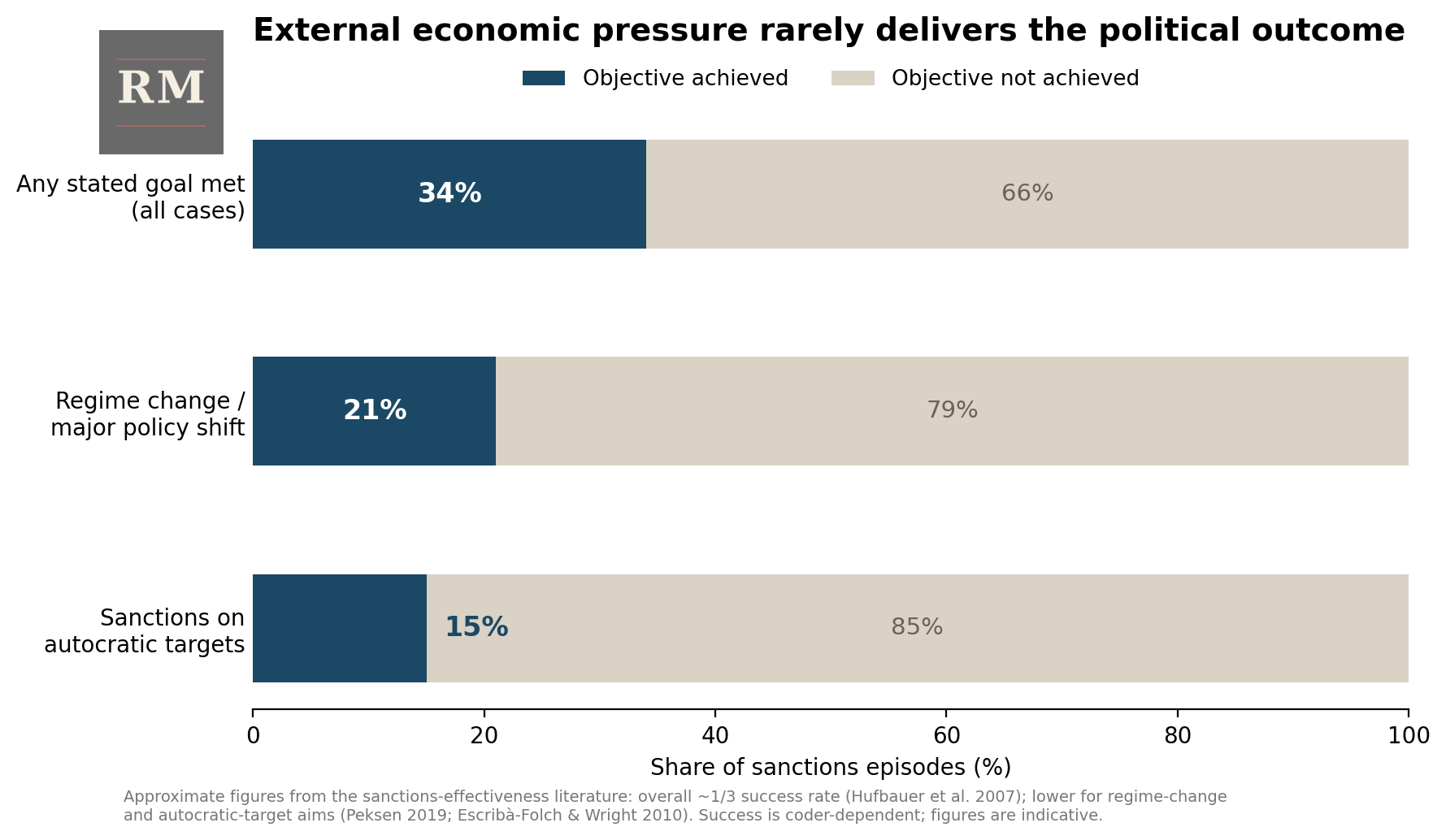
None of this means sanctions do nothing. It means their modal effect is economic damage absorbed by a public that can’t convert it into political pressure, which is the same failure mode as a domestic crisis—now with a foreign return address the regime can point to.
What a Crisis Would Actually Need to do
None of this means autocratic regimes are immune to economic collapse — Romania is proof they aren’t. It means the relevant question isn’t “how bad is the economy.” It’s whether a crisis can produce a villain concrete enough that blame-displacement can’t absorb it and land the pain on the regime’s own coalition rather than the public outside it—at the same time. A crisis that manages neither can be historically enormous, as Venezuela’s was, and still not shift the regime on its own; it took a foreign power physically removing the president to finish what thirteen years of collapse and sanctions couldn’t. A crisis that manages both can be comparatively modest, as Romania’s was, and end a government within a week from the inside.
It also explains why the sanctions record looks so erratic on the surface and so uniform underneath. Comprehensive, targeted, unilateral, coordinated — every design is a bet on forcing one of those two failures, placed against regimes that built the defenses for both while surviving their own collapse.
References
Aaskoven, L., & Grundholm, A. T. (2021). Stability through constraints: The impact of fiscal rules on autocratic survival. Democratization, 28(8), 1564–1582.
Esen, B., Gümüşçü, S., & Yavuzyılmaz, H. (2024). Competitive yet unfair: May 2023 elections and authoritarian resilience in Turkey. South European Society and Politics, 28(3), 359–387.
Fails, M. D. (2020). Are electoral autocracies better for the poor? Evidence from social assistance programs. Research and Politics, 7(3).
Guriev, S., & Treisman, D. (2019). Informational autocrats. Journal of Economic Perspectives, 33(4), 100–127.
Han, K. (2021). Autocratic welfare programs, economic perceptions, and support for the dictator: Evidence from African autocracies. International Political Science Review, 42(3), 416–429.
Morales-Arilla, J. (2025). Autocrats in crisis mode: Strategic favoritism during economic shocks. SSRN Working Paper.
Powell, G. B., & Whitten, G. D. (1993). A cross-national analysis of economic voting: Taking account of the political context. American Journal of Political Science, 37(2), 391–414.
Rozenas, A., & Stukal, D. (2019). How autocrats manipulate economic news: Evidence from Russia’s state-controlled television. Journal of Politics, 81(3), 982–996.
Thank you for this thoughtful essay and the interesting data. But I think the data can be interpreted in a number of ways and the difference between liberal democracies and autocracies may be more in style than in substance.
A change of ruling party in an electoral democracy does not necessarily constitute regime change. In fact, it usually means the opposite: Tweedledum loses power and Tweedledee takes its place, while the underlying machine continues to operate. Since there is only Tweedledum in autocracies, their departure is difficult short of a revolution. The authoritarian democracies are somewhere in between.
Whatever one may think of the rest of his politics, Lenin was probably right about the preconditions for regime change—or revolution, as he called it: (a) the rulers can no longer rule as before; (b) the ruled want radical change; and (c) there is a competent agent capable of organising and directing that change. Lenin called this the party of the proletariat, but the agent need not take that form.
Nor does the agent of change necessarily have to be entirely internal. The Ukrainian Maidan revolution is an interesting case here—and, curiously, it does not appear in your charts.
I personally think revolution is something close to a political singularity: a rare event in the history of any nation. It occurs when the existing elites are no longer capable of forming a new consensus within the existing political order. Economic crisis may create the conditions for such a rupture, but it does not, by itself, produce one.